
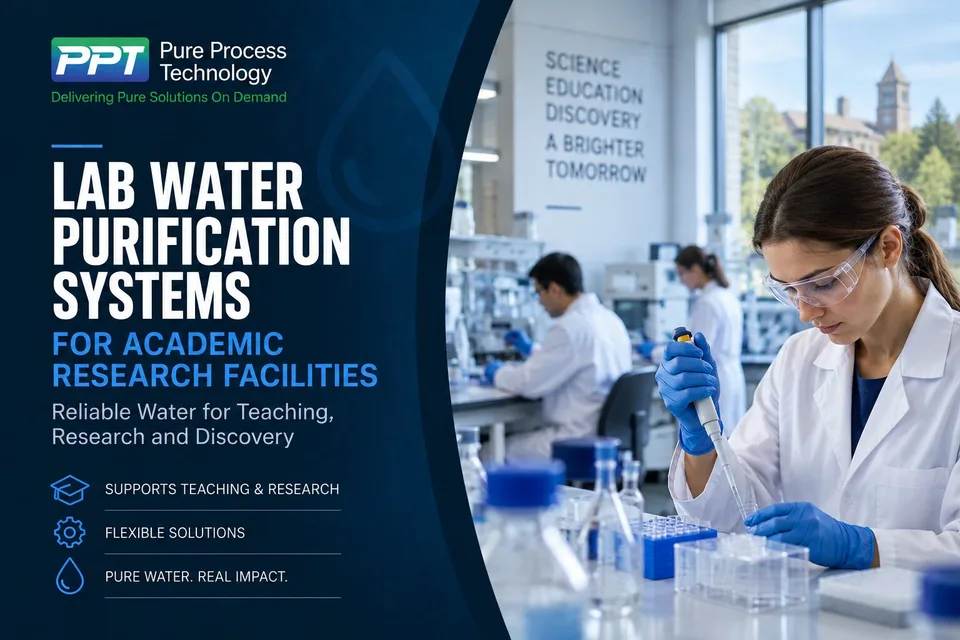
Academic research facilities rarely have one simple purified-water requirement.
A chemistry lab may need Type II water for routine reagent preparation. An analytical lab may need Type I water for HPLC or mass spectrometry. Teaching laboratories may need reliable purified water at several benches. Autoclaves, glassware washers, environmental chambers, and other equipment may have their own feedwater specifications.
Universities also face practical constraints that commercial laboratories may not: older buildings, limited mechanical space, multiple departments sharing infrastructure, grant-driven equipment purchases, changing research programs, and laboratories that may be renovated independently over many years.
Selecting the right research lab water purification system means looking at the entire facility rather than choosing equipment from a gallon-per-day rating alone.
Pure Process Technology designs water purification systems for academic laboratories ranging from compact point-of-use applications to larger centralized water systems serving multiple labs or departments.
What Water Quality Does an Academic Research Lab Need?
There is no single university laboratory water specification.
The required water quality depends on the work performed in each space.
Common academic applications include:
- Reagent and buffer preparation
- General chemistry
- Molecular biology
- Cell culture
- HPLC
- LC-MS
- PCR
- Spectroscopy
- Glassware rinsing
- Autoclave feed
- Laboratory washers
- Teaching labs
- Environmental testing
- Materials research
- Engineering research
- Shared core facilities
Some applications may operate properly with RO or Type III water. Others may require Type II water. Highly sensitive analytical work may require Type I water.
For a full comparison of common laboratory water grades, read Type I vs. Type II vs. Type III Water: What Does Your Lab Actually Need?.
The goal is not to provide every laboratory with the highest purity possible. The goal is to provide the appropriate water quality for each application.
Why University Water Systems Can Be Complicated
Academic facilities tend to change.
A laboratory built for organic chemistry today may support another research group several years from now. New instruments may be purchased through grants. Departments expand, move, merge, or renovate. A building may contain infrastructure installed during several different renovation cycles.
That creates several planning challenges.
Different Labs Need Different Water Qualities
A teaching chemistry lab and a shared analytical core may be located in the same building but have very different requirements.
Supplying every point with Type I water may waste treatment capacity and increase operating costs.
A better design may produce a lower water grade centrally and provide additional polishing only where higher purity is required.
Demand Can Change Quickly
A new research group, instrument, autoclave, or washer can significantly increase purified-water demand.
Systems designed too closely around current usage may have little room for future research activity.
Mechanical Space Is Often Limited
Many university buildings were not originally designed around modern laboratory infrastructure.
Water equipment may need to fit into:
- Mechanical rooms
- Utility closets
- Equipment alcoves
- Laboratory cabinets
- Hallway utility areas
- Existing service spaces
Compact equipment may be more practical in one building, whereas another facility may have room for a centralized skid and storage system.
Several Departments May Share One System
A central system can serve multiple floors, departments, or laboratories.
That can reduce the number of individual purification units, but distribution, storage, peak demand, maintenance access, and future expansion all become more significant.
Point-of-Use Water Systems for Research Labs
Point-of-use systems work well when purified-water demand is relatively small or isolated.
They can be a good fit when:
- One laboratory needs purified water
- Only a few nearby benches need water
- Adding a distribution loop would be difficult
- The building has limited mechanical infrastructure
- One research group has a specialized requirement
- A renovation affects only part of the building
PPT’s MiniLab water purification system provides a compact option for lower-demand laboratory applications.
For laboratories needing greater production or shared RO/DI capability, QuickLab provides a larger configurable platform for common laboratory water requirements.
Point-of-use equipment can also make phased renovations easier. A university does not necessarily need to rebuild an entire building’s water infrastructure every time one laboratory changes.
Centralized Water Systems for University Facilities
A centralized water system may make more sense when several laboratories share similar requirements.
Typical applications include:
- Multi-floor science buildings
- Shared research facilities
- Core laboratories
- Centralized glassware washing
- Several autoclaves
- Multiple departments
- Large chemistry or biology facilities
- New laboratory buildings
A central system may include:
- Pretreatment
- Reverse osmosis
- Deionization or EDI
- Storage
- Distribution pumps
- Recirculating piping
- UV treatment
- Filtration
- Water-quality monitoring
- Controls
PPT’s SkidSpec high-purity water system is designed for higher-capacity installations, distribution loops, and facility-scale applications.
For a broader comparison of these architectures, read Centralized vs. Point-of-Use Water Purification Systems.
Hybrid Systems Can Work Well on Campus
Many universities do not need to choose completely between centralized and point-of-use purification.
A hybrid design can use both.
One example:
- Produce RO or Type II water centrally.
- Store and distribute that water throughout the science building.
- Supply routine laboratory applications directly.
- Add local Type I polishing at analytical instruments or core facilities.
- Add dedicated treatment where an application has unique requirements.
This prevents the university from producing every gallon at the highest purity used anywhere in the building.
It also gives individual research groups more flexibility.
How Much Water Does a Research Facility Need?
Daily volume matters, but it is not enough by itself.
A university water system should account for:
- Average daily consumption
- Peak hourly demand
- Number of laboratories
- Number of users
- Points of use
- Washer demand
- Autoclave demand
- Instrument feed requirements
- Simultaneous use
- Class schedules
- Research schedules
- Storage
- Planned renovations
- Future laboratory growth
Teaching laboratories can create particularly unusual demand patterns.
A building may use relatively little water for part of the day, then several sections begin laboratory work around the same time.
Research buildings can also experience bursts of demand from washing, sterilization, media preparation, or batch work.
For a detailed sizing process, read How to Size a Lab Water Purification System.
Why Storage Matters
Storage allows the purification equipment to produce water steadily rather than matching every short-term demand spike.
Consider a science building with:
- Two glassware washers
- Several autoclaves
- Multiple laboratory taps
- Research equipment
- Teaching labs
If several users draw purified water at once, instantaneous demand may be much higher than average hourly consumption.
A properly sized storage tank can supply that short peak and refill afterward.
Storage design should account for:
- Tank capacity
- Purification production rate
- Refill time
- Turnover
- Distribution pressure
- Venting
- Materials
- Sanitization
- Microbial control
- Service access
The purification system and storage tank should be sized together.
Teaching Labs and Research Labs Have Different Needs
Universities often need to support both.
Teaching Laboratories
Teaching labs typically prioritize:
- Reliability
- Simple operation
- Multiple dispensing points
- Predictable water quality
- Reasonable operating cost
- Easy maintenance
Many teaching applications do not require Type I water at every bench.
RO, Type III, or Type II water may be more appropriate depending on the curriculum.
Research Laboratories
Research applications can be much more specialized.
One laboratory may need basic RO water. Another may need Type I ultrapure water for sensitive analysis.
That is another reason a staged water system can work well in academic buildings.
The university can supply a common water grade broadly, then apply additional treatment near specialized research equipment.
What About HPLC and Other Analytical Instruments?
Analytical instruments can have strict water-quality requirements.
Applications such as HPLC, LC-MS, molecular biology, and trace analysis may need very high-purity water with tight control over ionic, organic, particulate, or microbial contamination.
That does not mean the entire building needs to distribute Type I water.
Point-of-use polishing near the instrument can often provide the required quality using centrally produced purified water as feed.
This can reduce treatment burden and protect high-purity consumables.
Water for Autoclaves and Glassware Washers
Academic laboratories often have several equipment loads beyond direct dispensing.
Autoclaves may require RO, DI, RO/DI, or another specified feedwater quality depending on the sterilizer.
See What Water Quality Does an Autoclave Need? for more detail.
Glassware washers may use municipal water for initial wash stages and purified water for final rinsing.
See What Water Quality Does a Laboratory Glassware Washer Need? for more information.
These equipment loads need to be included when sizing a shared university water system.
Feedwater Quality Matters
Incoming municipal water varies between campuses and municipalities.
Feedwater information should include:
- Hardness
- Conductivity
- Chlorine
- Chloramine
- Silica
- Iron
- Manganese
- pH
- Temperature
- Pressure
These conditions can affect:
- Pretreatment
- RO membrane performance
- DI consumption
- Recovery rate
- Maintenance frequency
- Operating cost
A university may also have multiple buildings supplied through different utility infrastructure, so feedwater conditions should not always be assumed to be identical campus-wide.
Older Buildings Create Distribution Challenges
Existing academic buildings can make purified-water distribution difficult.
Potential issues include:
- Long pipe routes
- Limited ceiling access
- Crowded utility chases
- Inaccessible mechanical spaces
- Multiple renovation generations
- Long distances between laboratories
- Few available shutdown windows
In these buildings, installing a large new loop may not always be practical.
A combination of local MiniLab or QuickLab systems may be easier to implement.
New buildings or major renovations offer more opportunity to plan centralized distribution around long-term facility needs.
Planning for Future Research Programs
Universities frequently purchase equipment years after the original laboratory renovation.
A water system should leave reasonable room for new applications.
Potential future changes include:
- Additional faculty
- New research programs
- More analytical instruments
- New autoclaves
- Added glassware washers
- Increased teaching enrollment
- Expanded core facilities
- New laboratory suites
The system does not need to be dramatically oversized, but future capacity should be discussed during planning.
Which PPT System Fits an Academic Research Facility?
| Facility Need | Likely PPT Starting Point |
|---|---|
| Small research lab or isolated application | MiniLab |
| Moderate lab demand or shared RO/DI | QuickLab |
| Multi-lab building or central distribution | SkidSpec |
| Specialized sanitary or regulated application | SaniSpec |
| Complex campus or facility requirements | Custom Engineered Solutions |
These are starting points rather than automatic recommendations.
The right system depends on water quality, feedwater, daily consumption, peak demand, storage, distribution, available space, maintenance, and future expansion.
When Does a Custom Water System Make Sense?
Some academic facilities do not fit a standard package.
A custom-engineered water purification system may make sense when a project includes:
- Several laboratory buildings
- Large central storage
- High flow rates
- Multiple water grades
- Existing utility integration
- Unusual feedwater
- Redundant treatment
- Specialized controls
- Restricted mechanical space
- Complex distribution
- Future building expansion
Universities planning major science-building renovations can benefit from reviewing the water system early rather than treating purification as an equipment purchase near the end of the project.
Maintenance Matters in Shared Academic Systems
A failed point-of-use system may interrupt one laboratory.
A failed centralized system can interrupt an entire building.
Preventative maintenance becomes increasingly significant as more users depend on one system.
Maintenance may include:
- Pretreatment replacement
- RO membrane monitoring
- DI replacement
- UV lamp service
- Filter changes
- Sanitization
- Instrument calibration
- Pump inspection
- Alarm testing
- Water-quality testing
PPT provides water purification system service and support for preventative maintenance, repairs, troubleshooting, system assessments, and upgrades.
Service planning should be part of the original system design, particularly for shared systems supporting multiple research groups.
Budgeting for a University Water System
Initial equipment price is only one part of the cost.
Universities should also account for:
- Plumbing
- Electrical work
- Distribution piping
- Storage
- Installation
- Controls
- Consumables
- Membranes
- Filters
- DI media
- Service labor
- Water use
- Wastewater
- Equipment downtime
A less expensive system can cost more over time if it requires excessive consumables, frequent service, or several separate installations.
A lifecycle view provides a better comparison than purchase price alone.
Common Academic Lab Water System Planning Mistakes
Designing Around One Research Group
Faculty and research programs change.
Where practical, design the underlying infrastructure around broader facility needs rather than one temporary laboratory configuration.
Producing the Highest Purity Everywhere
Not every teaching bench or laboratory sink needs Type I water.
Match the purity level to the application.
Ignoring Class and Research Schedules
Peak demand can occur when many laboratories begin work at similar times.
Forgetting Equipment Loads
Autoclaves and washers can represent significant purified-water demand.
Adding New Equipment Without Reviewing Capacity
A new research grant may add instruments or equipment that the existing water system was never designed to support.
Treating Distribution as an Afterthought
Water quality and pressure can change between the purification system and the point of use.
Designing Without Service Access
Filters, membranes, pumps, tanks, and controls need room for maintenance.
Academic Research Water System Planning Checklist
Before selecting a university lab water system, document:
- Laboratories served
- Research applications
- Teaching applications
- Required water grades
- Number of users
- Points of use
- Daily demand
- Peak demand
- Autoclave requirements
- Washer requirements
- Instrument requirements
- Feedwater quality
- Storage
- Distribution
- Available mechanical space
- Building constraints
- Monitoring
- Maintenance access
- Redundancy
- Planned renovations
- Future capacity
PPT’s Lab Water System Specification Checklist for Engineers provides a more detailed framework for collecting these requirements.
Academic Research Lab Water FAQs
What type of water does a university research lab need?
It depends on the work being performed. General laboratory applications may use Type II or Type III water. Sensitive analytical work may require Type I water.
Do teaching laboratories need Type I water?
Usually not for every application. Teaching labs often use lower-purity laboratory water unless a specific experiment or instrument requires higher purity.
Can one water system supply several university laboratories?
Yes. Centralized systems can supply multiple laboratories when production, storage, pressure, distribution, and water quality are planned around the combined demand.
Is a central water system better than individual lab systems?
Neither approach is always better. A centralized system may work well for a large science building. Individual MiniLab or QuickLab systems may be easier to install in older buildings or isolated laboratories.
Can a university add Type I water later?
Often, yes. A facility can distribute a lower water grade and install local polishing equipment where Type I water is required.
How should a university size a lab water system?
Sizing should include daily demand, peak use, equipment loads, storage, simultaneous demand, and future growth.
See How to Size a Lab Water Purification System for a detailed planning process.
Planning a Water Purification System for an Academic Research Facility?
University water systems need to support today’s research without making tomorrow’s laboratory changes unnecessarily difficult.
Water quality, capacity, storage, distribution, space, equipment loads, maintenance, and future growth all affect the right system design.
Pure Process Technology works with research laboratories and facility teams on systems ranging from compact MiniLab and QuickLab installations to larger SkidSpec and custom-engineered water systems.
You can also review PPT’s Academic Research & Labs capabilities for university and research applications.
If you’re planning a new laboratory, science-building renovation, central water system, or expansion of an existing system, request a Water System Spec Review.
PPT can review your applications, water-quality requirements, demand, storage, distribution, and facility conditions before the system specification is finalized.